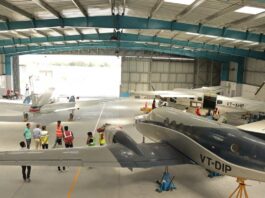
In an industry where ambition is abundant but survival is rare, India’s aviation sector is entering its most defining phase yet – a quiet simultaneous consolidation.
The Unlimited Opportunity
India’s aviation story today is nothing short of extraordinary.
Airlines placing record aircraft orders (over 1,500+ aircraft on order across Indian carriers)
Airports expanding at unprecedented pace (from approx 74 operational airports in 2014 to 150+ airports, heliports and water aerodromes today)
Passenger traffic soaring (domestic air passengers crossing 150+ million annually, nearly doubling over the past decade)
New entrants across MRO, CAMO, FTO, logistics, leasing, drones
Policy push for self-reliance and indigenous capability
On paper, it looks like a gold rush.
And like every gold rush, it is attracting Entrepreneurs, First-time aviation investors and of course the Opportunistic capital
But those who have spent decades in this industry know one thing:
Aviation is not only an entry game. It is a game of survival & continuous scaling.
The Reality Few Talk About
Behind the optimism lies a hard truth that is taught in management classes:
Only about 30% of new ventures in most industries survive beyond 3 years
Barely 15 – 20% make it past 5 years
Profitability is often a long-term outcome – not an early milestone, lest you are extremely innovative or have god-fathers in the political arena.
Seasoned businessmen, irrespective of industry often say:
“Don’t enter aviation to make money in 3 years. Enter it only if you can afford to lose money for 5.”
And that is not pessimism – it is experience speaking.
Why Most Aviation Startups Fail
Having observed multiple cycles of aviation growth, a pattern becomes clear:
1. Underestimating Capital Intensity
Aviation consumes capital relentlessly:
Infrastructure
Skilled manpower
Compliance
Maintenance
Cash flow gaps appear faster than anticipated.
2. Regulatory Timelines vs Business Timelines
Approvals – from the Directorate General of Civil Aviation (DGCA) – rarely align with business projections.
I recall a recent case where an enthusiastic new entrant representing a large indian conglomerate with estimated annual turnover of more than 20000 crores, was introduced by me to DGCA officials (vertical heads) and the DG, DGCA with plans to start a specific type aircraft production in India under DGCA’s CAR 21 provisions. After making high-level presentations and overseas training plans for its engineers, the reps confidently projected aircraft production to commence within next four months. The regulator, in its characteristic composure, encouraged the optimism without dampening spirits.
A year later, reality has quietly taken over – timelines have stretched, momentum has slowed, and some of those freshly trained engineers and staff are now reconsidering their career paths. To those who think otherwise:
A gentle reminder that in aviation, regulatory timelines are governed by safety – not spreadsheets.
This unaccounted mismatch often results in Delays that translate into => Costs. Costs in turn transalte into => Pressure and Pressure ultimately into => Compromise.
3. Fragmented Ecosystems
Many new players attempt to build everything in-house, viz:
Compliance: Internal audits, though fine, still need to be complemented with third party audit’s and audit preparations for keeping up with DGCA requirements.
Logistics
Result is obvious?
High cost, low efficiency, and increased risk exposure.
4. Absence of Strategic Depth
Aviation rewards:
Experience
Relationships – Networking dwarfs the likes of digital marketing in Aviation.
Post-COVID Boom Followed by the beginning of a Slow Shakeout
The post-pandemic rebound has accelerated:
Fleet expansion
New company formations
Entry into niche verticals
But history – globally and in India – tells us:
Every boom irrespective of Industry is followed by consolidation.
And in India, that consolidation is no longer theoretical.
It has already begun, albeit silently.
The Adani Effect: A Case Study in Real-Time Consolidation
If one needs evidence of consolidation, look no further than the rapid expansion of Adani Group in aviation.
In a short span, Adani has systematically built an integrated aviation ecosystem:
1. Acquisition of Air Works
~85% stake acquired for ~₹400 crore
One of India’s largest independent MRO players
Pan-India presence with extensive technical capabilities
2. Full Acquisition of Indamer Technics
Strategic Nagpur-based MRO facility
Designed to handle heavy maintenance and lease return checks
Strengthens India’s position as a potential global MRO hub
3. Majority Stake in Flight Simulation Technique Centre (FSTC)
Deal valued at about ₹820 crore
India’s largest independent pilot training organisation
Critical piece in building a full-stack aviation services platform
What This Really Means
This is not just expansion, it’s a strategic consolidation across verticals:
Maintenance (MRO)
Training (FTO/Simulation)
Infrastructure (Airports)
Defence & aerospace
The objective is clear: create a single-point aviation ecosystem.
And this has two immediate implications:
1. Scale Will Dominate
With the Competition Act 2002 (the erstwhile monopolies and restrictive trade practices act 1969) barely effective, standalone players will struggle to compete with:
Integrated offerings
Capital strength
Cross-vertical synergies
2. Independent Players Must Choose
They have limited choices and must decide to:
Scale up
Partner
Merge
Or exit
The Silent Struggle of Smaller Players
While large groups consolidate, smaller aviation businesses face:
Rising compliance costs
Talent retention challenges
Pressure from clients demanding scale
Limited access to capital
Many are:
Operationally sound
Technically competent
But financially stretched
These are the very entities that become:
ACQUISITION TARGET – OR CASUALTIES.
Aviation’s New Reality: Collaboration Over Competition
The old mindset “Build Everything Yourself & Be the Lone Sahara Shree” is being replaced with a new reality i.e. “Integrate, Collaborate, Or be Irrelevant”. A learning thus, if comes earlier, the better. We are already seeing:
MROs aligning with investors
Operators outsourcing CAMO and Maintenance
Training organizations seeking partnerships
Logistics providers integrating into aviation ecosystems
A Strategic Insight from Experience
Having spent decades in aviation, one pattern stands out:
The strongest aviation businesses are rarely built alone. The era of Naresh Goyal’s (Aviation) and Prannoy Roy (Media Industry) are over
They are built through:
Strategic alliances Consortiums
Smart acquisitions
Timely exits
Integrated ecosystems
Pick up any mid-sized or emerging aviation company in the West – be it an MRO, charter operator, training organization, or even a new-age aerospace startup – and look at their “About Us” or “Leadership” pages. What you’ll consistently find is not a single dominant promoter, but a well-structured mix of investors, aviation veterans, technical specialists, and professional management teams.
Take Surf Air Mobility or Wheels Up – both operate on models where capital partners, operational experts, and strategic leadership coexist, rather than being driven by a single individual. Similarly, many regional MROs and flight training organisations across Europe and North America are backed by private equity, institutional investors, and domain experts, each bringing a specific capability to the table.
The era of promoter-driven aviation empires is giving way to professionally managed, investor-backed ecosystems – where ownership is distributed, but accountability is sharper.
In a sector as capital-intensive and safety-critical as aviation, this shift is not incidental – it is essential.
The Smart Playbook for the Next 5 Years
For entrepreneurs and investors entering aviation today:
1. Don’t Chase Growth – Secure Survival First
Survival beyond 5 years is the real milestone.
2. Build Asset-Light Where Possible
Leverage:
Third-party MRO
External CAMO
Strategic logistics partners
3. Be Open to Consolidation Early
The best deals happen:
Before distress
Not after
4. Align with Industry Experts
Well known saying, “There is No Shortcut to Experience”. Experience reduces:
Costly mistakes
Regulatory friction
Time to market
5. Think Ecosystem, Not Entity
Standalone companies will struggle.
Integrated ecosystems will thrive.
To Conclude: The Future Belongs to the Consolidated
India’s aviation sector is not just growing – it is maturing.
And maturity brings:
Consolidation
Discipline
Selectivity
In the coming decade, success will not be defined by entry – but by endurance.
The question is no longer “SHOULD YOU CONSOLIDATE?”. Rather the real question is “WHEN – AND WITH WHOM?”
Last But Not The Least:
Those in sync with my thoughts, or those exploring mergers and acquisitions, operators seeking strategic partnerships or Investors looking for structured aviation entry routes, can express their thoughts below or get in touch.