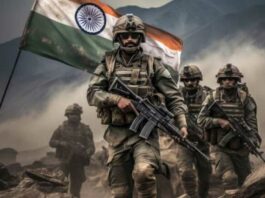
Border security is of serious concern globally. The US has deployed its Stryker Brigade at the US-Mexico border and offered 250 used Stryker ICVs to Poland for one dollar apiece in December 2025. Yet, the US managed to politically pressure India for joint production of this vintage ICV. Mercifully, this went on the backburner after Stryker trials in high-altitude failed miserably but time was wasted in equipping the Army with the indigenous Wheeled Armoured Platform (WhAP), also being exported to Morocco.
India has a volatile neighbourhood and land borders measuring 15,200-km, with the longest border with Bangladesh – 4,096.7 km. China and Pakistan are in illegal occupation of Indian territories and eye more. The border with Myanmar is not fully settled. About 800–860 km of the India-Bangladesh border remains unfenced, with over 174 km classified as non-feasible for fencing due to riverine areas and marshy lands.
India has faced terrorism since Independence. A surgical strike, standoff Balakot strike, and killing 100 terrorists in Operation ‘Sindoor’ can’t suffice against a country churning out 1.00.000 radicals annually from 32,000 madrassa. Cross-border tunnels are being used by our adversaries for infiltration and smuggling along our borders with Pakistan, Bangladesh and Myanmar. We lack a doctrinal approach for proactive tunnel warfare. India’s strategy has a defensive mindset where infiltrators are dealt with after they enter our territory. Despite an Armed Forces Special Operations Division, in addition to a large number of Special Forces in the Services, the focus is more on optics, like the clip on Bhairav Commandos using Amitabh Bacchan’s background voice.
All this is because India still doesn’t have a National Security Strategy (NSS) despite NSA Ajit Doval officially tasked to define one in 2019. Lack of NSS, helps the political hierarchy to avoid responsibility in crisis situations. Government focus remains on elections, trade, money-making and of late on Epstein Files. When and why the US released Epstein Files containing names of PM Modi, Hardeep Puri and Anil Ambani, and how Trump is using is using Epstein Files as a strategic weapon to delete names from these files, plus Trump’s other pressure points on India, can be read here. Despite Indian efforts to appease Trump, the US has slapped 126% tariffs on India solar exports after Adani’s firm withdrew from the probes. Hardeep Puri’s Epstein connection and the riches secured by his daughter continues to trend the internet. But India always has intra-party and inter-party skeletons, so there is nothing to worry about.

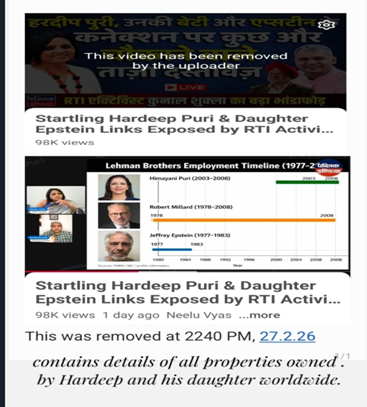
But New Delhi should worry about the Epsteins in India. Maharashtra Chief Minister Devendra Fadnavis has said 1,17,369 women and minor girls went missing during 2024-2025 in Maharashtra, of whom 86,228 the police traced but 31,141 are still missing. If this is the state in one state, imagine the numbers pan-India. How many such rackets are linked to politicians? Fadanavis has also launched a rifle and combat training program for Dalit and Nav-Buddhists youth – a private-political army? But what is India doing about politicians abusing, thrashing and in one case even making a Dalit drink his own urine? News of such incidents come in media but never the follow up of what action was taken against the concerned politician (s).
In February 2026, the Ministry of Home Affairs (MHA) announced India’s first-ever National Counter-Terrorism Strategy ‘PRAHAAR’: zero-tolerance against terrorism. PRAHAAR is an acronym for: Prevention of terror attacks to protect citizens; Responses that are swift and proportionate to the threat; Aggregating internal capacities for synergy; Human rights and ‘Rule of Law’ based processes; Attenuating the conditions enabling terrorism; Aligning and shaping international efforts; Recovery and resilience through a whole-of-society approach.
This strategy, coming after India suffered thousands of terror attacks over the years indicates the seriousness or lack of it in combating terrorism. How effective PRAHAAR is, including in dealing with criminalization of politics, only time will show. Why did we not react to the Delhi and Nowgam blasts, which had clear foreign links – fear of enemy retaliation? What happened to zero-tolerance?
In 2000, Farooq Abdullah, then Chief Minister of J&K, addressed a think tank in New Delhi. After the talk, a foreigner in the audience asked him, “Sir, there are 5-6 villages in J&K bang on the border that assist infiltration. Why not move them away from the border into the hinterland?” Abdullah replied, “We have those plans. I have asked INR 100 crore from the Centre to move the first village”. That was 26 years ago.
In recent years, control of up to 60 km of the border with Pakistan was given to the BSF for counter-drone operations, which led to plenty of discussion and controversy. The Army has now been made responsible for counter-drone operations along the Pakistan and China borders, managing low-altitude airspace within a 35-km range from the frontier. But ambiguity remains in coordinating counter-drone operations between the Army and the BSF, given internal politics. Why has the Army not been given responsibility for low-altitude airspace along the Bangladesh border when China and Turkey are supplying them drone? Is the fear that army surveillance will unveil the iniquitous activities under the very nose of the MHA?
In April 2025, Union Home Minister Amit Shah said an electronic surveillance system would be “first” installed along the Indo-Pak border in the next 3-4 years, and then on the India-Bangladesh border. Why can’t we address the Indo-Bangladesh border simultaneously? Why should the Indo-Pak border take 3-4 years in the first place – lack of resources or political will? Is the government waiting for BJP rule coming in Bangladesh to address the Bangladesh border effectively?
A decade back, India Today showed its reporter on the Indo-Bangladesh border standing next to a BSF jawan sitting on a chair and a stream of Bangladeshis entering India through the broken fence in broad daylight. The clip was taken off the TV within 10 minutes. A shocking video of an Indian youth crossing into Bangladesh territory in broad daylight with no one checking him was recently aired by Times Now. Obviously, illegal immigration and smuggling, including cattle-smuggling, is continuing and money is changing hands.
The Calcutta High Court has ordered the West Bengal government to hand over land for BSF fencing by March 31, 2026. The West Bengal government says it has no objection to providing land for fencing, land has already been provided to central agencies, but Centre must roll back the arbitrary decision to extend the BSF’s jurisdiction from 15 km to 50 km. This indicates that the issue really is not about fencing, but of BSF controlling all land within 50-km of the border.
- Union Home Minister Amit Shah is going around saying infiltration will be stopped if BJP rule comes to power in West Bengal, and if BJP returns to power in Assam, infiltration and flooding will be stopped. But multiple questions arise as under:
- Are we a bunch of eunuchs who cannot acquire land for border fencing or is this only about BSF control up to 50-km from the border?
- Why has the issue been taken up with Calcutta High Court after so many years – isn’t this deliberate dirty politicking? Doesn’t this demand accountability?
- Isn’t the BSF, which is directly under the MHA, responsible for the Indo-Bangladesh border? And, BSF has never said it is constrained in guarding this border?
- Isn’t the current situation conducive to enormous financial gains for the MHA, using BSF for infiltration, narcotics and cattle smuggling – as indicated by India Today in the past and Times Now recently.
Jibu B Mathews, commandant 83 Battalion BSF (resident of Pathanamthitta District of Kerala) was arrested by the CBI unit of Kochi travelling in Shalimar Express. He was carrying INR 76 lakhs when nabbed, and CBI recovered INR 96 crore from his house later. He was posted at the India-Bangladesh border at the time of his arrest. This is just a small sample of what is involved. Farooq Abdullah only wanted INR 100 crore to disregard national security, but here the sum involved would be many millions more. Wonder if the CBI got a rap for reporting the Mathews case and was directed to not report such cases in future.
When a reporter asked why the Home Minister can’t stop infiltration from Bangladesh, Amit Shah only sniggered, “woh bhabhiji wali (that sister-in-law), and that the BSF “cannot” guard the Bangladesh border without the fence – this after BJP ruling India since 2014? It amounts to admitting, as home minister, he has failed to provide adequate security along this border. How come he didn’t imprison Mamta Bannerjee and Mahua Moitra (like Arvind Kejriwal and Manish Sisodia in false cases) and took over West Bengal to secure the border – has he lost his touch?
Finally, when will we transcend from border insecurity to border security – 2047?
The author is an Indian Army veteran. Views expressed are personal.