
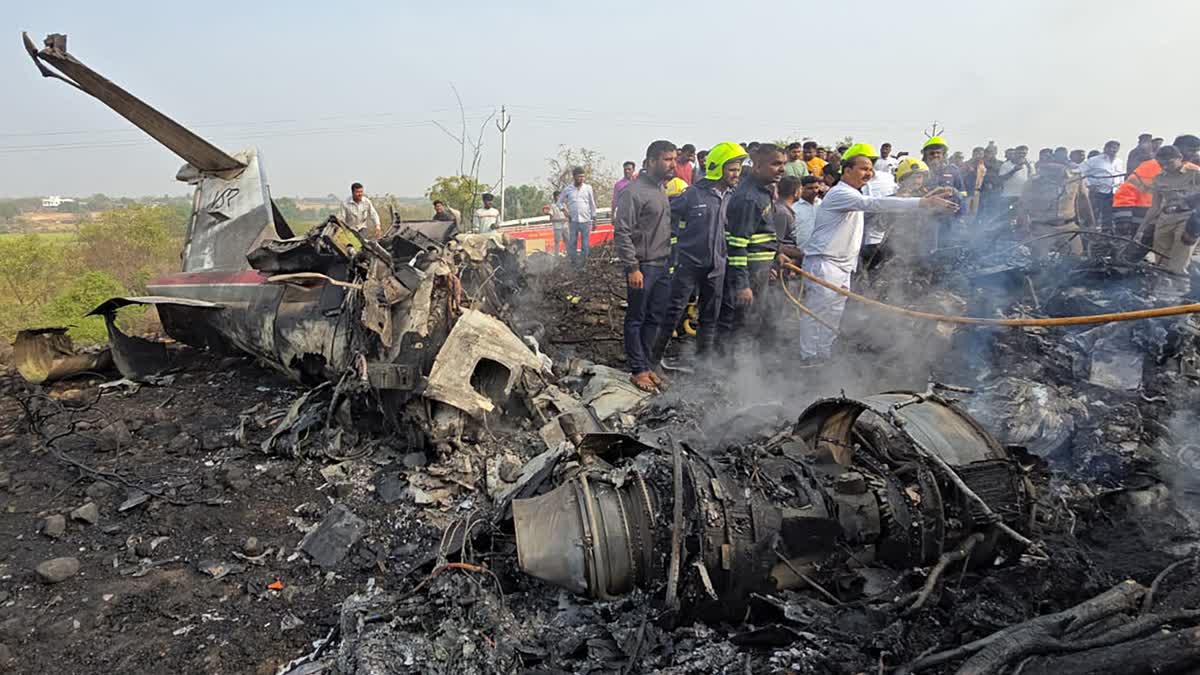
A 24-accident compilation spanning decades raises uncomfortable questions about pilot experience, operational pressure, maintenance discipline and the special challenges of VIP aviation
VIP status cannot come with a different safety standard
There is something uniquely unforgiving about aviation: the aircraft does not know who is sitting in the cabin. A Chief Minister, Governor, Union Minister, industrialist, pilot, engineer or first-time passenger is subject to the same aerodynamics, weather, mechanical limitations and human factors.
Yet VIP aviation is operationally different. It can involve compressed schedules, last-minute programme changes, security considerations, short-notice positioning, demanding itineraries and pressure to maintain the movement plan. None of these factors is inherently unsafe. They become unsafe only when the normal barriers that protect an aircraft from risk begin to bend.
A historical compilation of VIP-related air accidents in India, dated 1 September 2026 and shared for this article, provides a sobering statistical window into that problem. It records 24 accidents involving VIPs: 11 involving fixed wing aeroplanes and 13 involving helicopters. Sixteen of the 24 accidents are recorded as fatal, while 18 VIPs lost their lives.
The numbers deserve a closer look
| Aircraft | Accidents | Fatal Accidents | VIP Fatalities |
|---|---|---|---|
| Aeroplanes | 11 | 10 (90.9%) | 10 |
| Helicopters | 13 | 6 (46.0%) | 8 |
| Total | 24 | 16 (66.6%) | 18 |
The first striking feature is the difference between aeroplanes and helicopters. In the compilation, 10 of 11 aeroplane accidents are recorded as fatal. Among helicopters, six of 13 are recorded as fatal. These figures should not be interpreted as accident rates or comparative safety rates: the compilation does not provide exposure data such as flying hours, sectors, fleet size or passenger movements. They are simply the fatal/non-fatal distribution within this particular historical set.
There is another important caveat. The compilation brings together events from very different eras and circumstances. Some involved conventional civil-aviation operational accidents; others had unusual or security-related circumstances. For example, the 1965 death of Gujarat Chief Minister Balwantrai Mehta occurred when his aircraft was shot down during the India-Pakistan conflict. Such cases cannot legitimately be used to judge maintenance, pilot skill or contemporary regulatory oversight.
The value of the compilation therefore lies less in assigning blame and more in asking what lessons VIP aviation should extract from a long history of high-consequence operations.
Who were the VIPs?
| VIP category | Persons involved | Fatalities |
|---|---|---|
| Governor | 1 | 1 |
| Chief Minister / Former CM / Deputy CM | 11 | 6 |
| Ministers / Speakers | 10 | 7 |
| MPs / Political Leaders | 2 | 2 |
| Other VIPs | 2 | 2 |
| Total persons | 26 | 18 |
The category totals contain 26 VIP persons across 24 accidents because some accidents involved more than one VIP. The list includes political leaders from across the decades, including Governors, Chief Ministers, Ministers, Speakers and MPs, as well as figures such as industrialist-politician O.P. Jindal and scientist Homi J. Bhabha.
Recent history has also reminded the country that VIP aviation is not a historical problem. The death of former Gujarat Chief Minister Vijay Rupani in the 2025 Ahmedabad Air India crash and the 2026 Baramati Learjet accident involving Maharashtra Deputy Chief Minister Ajit Pawar have brought VIP aviation back into public attention. The Aircraft Accident Investigation Bureau continues to investigate such occurrences on an evidence-based basis; accident causation should therefore not be inferred before the statutory investigation is complete.
Experience is important – but hours alone do not make an aircraft safe
One of the most revealing parts of the compilation concerns the pilots. Across the recorded cases, the average age of the pilot-in-command is given as 45 years, with a minimum of 33 and maximum of 59. Average flying experience is listed at 5,598 hours, with a minimum of 702 and maximum of 13,685 hours.
| Parameter | Aeroplane PICs | Helicopter PICs | Overall |
|---|---|---|---|
| Average age | 42 years | 48 years | 45 years |
| Maximum age | 61 years | 58 years | 59 years |
| Minimum age | 28 years | 39 years | 33 years |
| Average experience | 7,370 hrs | 4,357 hrs | 5,598 hrs |
| Maximum experience | 18,855 hrs | 8,514 hrs | 13,685 hrs |
| Minimum experience | 328 hrs | 1,077 hrs | 702 hrs |
That should immediately challenge a comfortable assumption: that a highly experienced pilot automatically eliminates risk. It does not. Experience is a critical safety barrier, but currency, aircraft-specific proficiency, route familiarity, weather assessment, crew resource management, decision-making and the willingness to reject an unsafe request are equally important.
A 10,000-hour pilot flying an unfamiliar helicopter type, or a highly experienced commander operating under severe time pressure, is not necessarily in the same risk environment as a pilot who is current, well-rested, type-proficient and empowered to say ‘no’. VIP aviation therefore needs competence management, not simply a logbook-hour mentality.
The invisible pressure around VIP operations
The most difficult safety threats are often the ones that never appear in an accident photograph. They are organisational. A VIP has a programme. The security team has a programme. The political establishment has a programme. The operator has an aircraft. The pilot has weather, fuel, aircraft limitations, duty-time considerations and a legal responsibility to make the final operational decision.
The safety system works only when the pilot and the technical organisation are protected from inappropriate commercial or protocol pressure. A delayed VIP movement may be politically inconvenient. An aircraft grounded for a defect may be financially painful. A rejected take-off or aborted mission may generate questions. But none of those consequences can justify compromising an airworthiness or operational decision.
This is precisely why modern Safety Management Systems matter. Safety cannot depend on the personal courage of one pilot, one engineer or one Continuing Airworthiness Manager. The organization must create systems in which raising a safety concern is normal – and overriding it is difficult.
India’s regulator has also demonstrated that VIP/VVIP operations require particular scrutiny. Following the January 2026 Baramati Learjet accident, the Ministry of Civil Aviation directed DGCA to conduct a special audit of the operator and also special audits of other major non-scheduled operators and aerodromes involved in VIP/VVIP operations. The scope included operational control, maintenance compliance, crew training, SMS and flight-record monitoring.
Where CAMO, maintenance and operations meet
For VIP operations, continuing airworthiness management becomes particularly important. A VIP aircraft cannot be treated as an aircraft that is simply ‘available when required’. Its maintenance status, deferred defects, component lives, Airworthiness Directives, Service Bulletins, configuration and technical records have to be under constant control.
The same principle applies to the maintenance organization. A technician or AME who identifies a defect must be able to record it without fear that an important passenger’s schedule will influence the technical disposition. An independent technical decision is not an inconvenience to VIP operations – it is the foundation of VIP safety.
The strongest operators understand this distinction. They build buffers into planning, maintain appropriate crew and engineering depth, conduct robust pre-flight and weather assessments, and make it clear that a VIP schedule never becomes a technical approval.
India’s wider civil aviation safety picture
The VIP compilation should also be viewed against the broader Indian safety environment. Official Aircraft Accident Investigation Bureau statistics record 117 accidents and 131 serious incidents/incidents investigated from July 2012 through June 2026. The figures span scheduled, non-scheduled, training and other civil aviation operations.
That is a reminder that safety is not a VIP-specific issue. VIP operations simply make the consequences more visible because the occupants are public figures and the aircraft often receive extraordinary public attention after an accident.
The real test of a mature aviation system is therefore not whether it can protect a VIP after an accident. It is whether it can prevent the accident while nobody is watching.
The lesson is simple: VIP aircraft need more discipline, not more privilege
The historical record presented here should not become another list of names followed by a familiar cycle of outrage, investigation and forgetfulness. It should be treated as a safety-learning opportunity.
VIP flying requires the same fundamentals as every other civil aviation operation – but often with stronger safeguards because the operational environment can be more complex. Selection of competent crews, type and route proficiency, fatigue management, weather discipline, robust maintenance and CAMO oversight, effective SMS, independent technical decision-making and a culture that accepts cancellation without stigma are not optional extras.
The most important lesson may be the simplest: an aircraft carrying a VIP does not need a VIP safety standard. It needs an uncompromised aviation safety standard.
India’s civil aviation sector is expanding rapidly, and non-scheduled and general aviation operations are growing alongside scheduled airlines. As that ecosystem grows, VIP aviation will remain an important part of the national transport and governance landscape. The opportunity now is to make its safety culture exemplary – not because the passengers are VIPs, but because every passenger deserves the same uncompromising protection.
Source & Methodology
The historical VIP accident figures, names, dates, pilot-age and experience statistics reproduced in this article are based on data compiled by Commander M.K. Singh dated 1 September 2026. The compilation is not presented as an AAIB/DGCA statistical publication. The article does not infer accident causation from the VIP compilation. Final causal conclusions remain the responsibility of the statutory accident-investigation process.