


From Silent Custodian to Measurable Pillar of Safety in Aviation
Continuing Airworthiness Management Organisations (CAMOs) have long been described as the heart and soul of any aviation organisation. In our earlier article, “CAMO: The Heart & Soul of Airline Safety & Efficiency”, we examined why CAMO oversight is central to flight safety, operational reliability, and asset value preservation, and how failures in CAMO oversight – often invisible until it is too late – have contributed to catastrophic outcomes globally.
Building upon that foundation, this article takes the discussion a step further. It proposes a structured, objective CAMO Performance Evaluation Framework for India, inspired by the Directorate General of Civil Aviation’s (DGCA) successful initiative to rate Flying Training Organisations (FTOs) – a move widely appreciated for introducing transparency, accountability, and continuous improvement into a critical segment of aviation.
The time has come to ask a difficult but necessary question:
If pilot training organisations can be rated for quality and safety outcomes, why should CAMOs – the custodians of airworthiness – remain unmeasured and unbenchmarked?
CAMO Under Pressure: Walking a Tightrope Every Day
Recent aviation incidents and accidents – both in India and globally – have once again drawn attention to the immense pressure under which CAMO post holders operate.
CAMO leaders routinely find themselves walking a tightrope:
- On one side, commercial pressure from operators to keep aircraft flying, minimise downtime, and control costs.
- On the other, regulatory expectations from DGCA, demanding absolute compliance, traceability, and proactive risk management.
Unlike flight operations or maintenance, CAMO failures are rarely dramatic or immediate. They manifest quietly – through deferred maintenance, missed trends, incomplete records, or configuration drift – until one day the system breaks.
History shows that when CAMO oversight weakens:
- Minor technical issues evolve into chronic reliability problems
- Asset values erode unnoticed
- Safety margins shrink silently
- Regulatory findings escalate from observations to enforcement actions
Conversely, when CAMO functions effectively, it:
- Prevents incidents before they materialise
- Saves crores in avoidable maintenance costs
- Preserves aircraft residual values
- Enhances safety culture across the organisation
Yet, despite its centrality, CAMO performance today is judged largely through periodic audits and reactive findings, rather than through continuous, data-driven benchmarking.
Learning from DGCA’s FTO Rating Initiative
DGCA’s introduction of FTO grading and categorisation has been a landmark step for Indian aviation. By formally recognising differences in:
- Training quality
- Infrastructure
- Safety oversight
- Instructor strength
the regulator has:
- Encouraged healthy competition
- Rewarded high performers
- Provided clarity to students and investors
- Created a roadmap for improvement
This initiative demonstrates that rating does not mean penalising – it means guiding the ecosystem toward higher standards.
A similar philosophy can – and should – be applied to CAMOs.
Why India Needs a CAMO Performance Evaluation Framework
India’s aviation ecosystem has matured rapidly:
- Fleet sizes are expanding
- Leasing exposure is increasing
- Foreign lessors and insurers are scrutinising Indian operators more closely
- General Aviation and NSOP operations are growing in complexity
In this environment, CAMO effectiveness directly impacts national aviation credibility.
A formal CAMO evaluation framework would:
- Move oversight from compliance-only to performance-oriented
- Identify best-in-class practices worth replicating
- Help weaker CAMOs recognise gaps early
- Provide regulators with trend-based supervisory tools
- Offer lessors and investors a clearer risk lens
Proposed CAMO Performance Evaluation Framework (India)
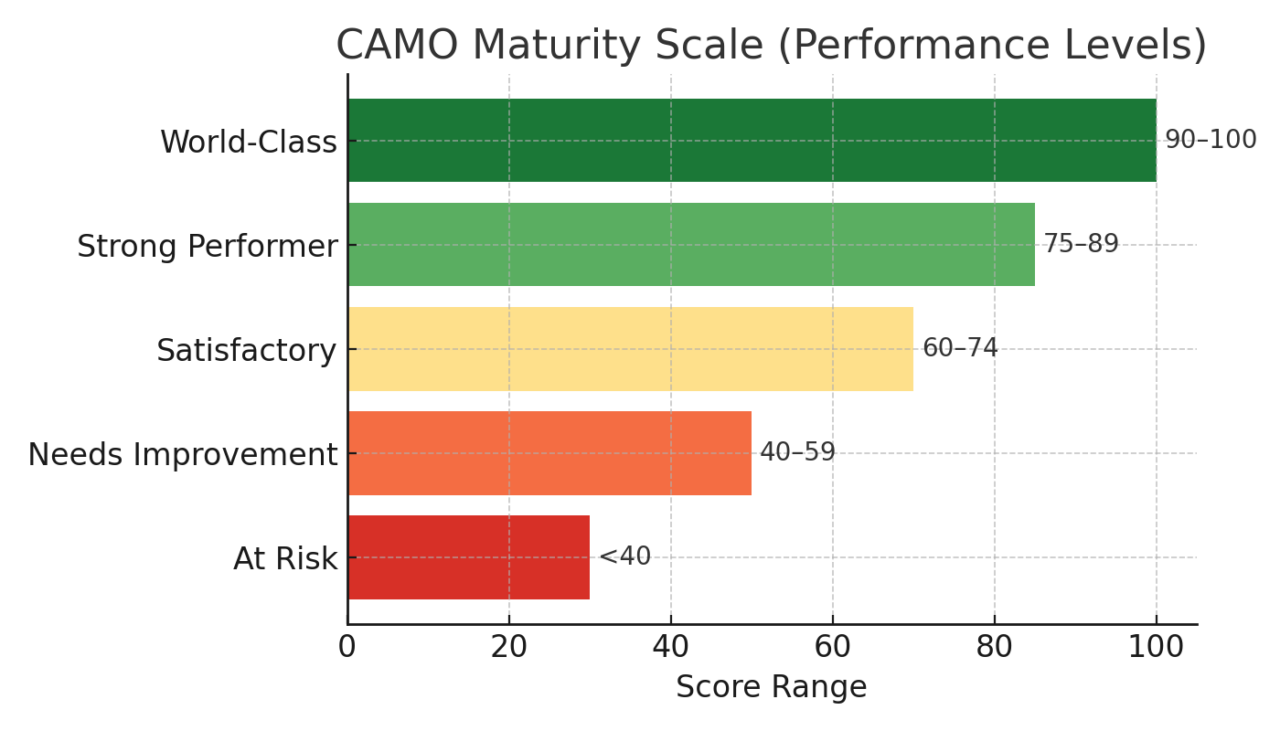
Based on industry experience, regulatory expectations, and global best practices, the following ten key performance parameters can objectively assess CAMO effectiveness. Each parameter is scored on a scale of 1–10, resulting in a cumulative score out of 100.
Key Evaluation Parameters
- Regulatory Compliance Record
Audit findings, CAR-M adherence, AD/SB incorporation discipline - Fleet Airworthiness Availability
Aircraft serviceability rates, AOG trends - Reliability Programme Effectiveness
Defect trending, data analytics, corrective action robustness - Maintenance Planning & Forecasting Accuracy
Predictive vs reactive maintenance culture - Technical Record Keeping & Digitalisation
Traceability, data integrity, digital maturity - Configuration Control & Modification Tracking
STC control, serial number accuracy - Human Resource Competence & Retention
Training depth, approvals, team stability - SMS Integration
CAMO participation in hazard identification and mitigation - Cost Efficiency & Asset Optimisation
Maintenance cost control without compromising safety - Innovation & Continuous Improvement
Use of AI, predictive maintenance, digital twins, automation
Scoring Interpretation
Below graphical representation depicts the distinctions amongst CAMO Organizations
Survey-Based Indicative Ranking (Illustrative)
As part of this study, a confidential perception-based survey was conducted among aviation professionals, lessors, engineers, and auditors, drawing on public data, audit histories, and industry feedback. While not a substitute for DGCA audits, the results offer meaningful directional insight.
Non-Scheduled Operators (NSOP) – CAMO Ranking
| Rank | Operator | Total Score (/100) |
|---|---|---|
| 1 | Pinnacle Air | Very Strong |
| 2 | Club One Air | Strong |
| 3 | Taj Air | Satisfactory |
| 4 | Fly Big | Satisfactory |
| 5 | Heritage Aviation | Needs Improvement |
Why Pinnacle Air stands out:
Industry feedback consistently highlights Pinnacle Air’s CAMO for:
- Disciplined configuration control
- Strong record integrity
- Proactive reliability monitoring
- Balanced decision-making under operational pressure
Its CAMO function is widely regarded as a benchmark for Indian General Aviation, demonstrating that excellence is achievable even outside large airline ecosystems. It offers a practical role model for both operators and regulators.
How This Framework Can Be Used
For DGCA
- Benchmark CAMO maturity
- Introduce incentive-based supervision
- Identify model CAMOs for replication
For Operators
- Self-audit objectively
- Prioritise investment areas
- Strengthen safety and asset outcomes
For Lessors & Investors
- Evaluate airworthiness risk
- Price leases and insurance more accurately
- Encourage governance discipline
Conclusion: From Silent Function to Measurable Excellence
CAMO has always been the unseen backbone of aviation safety. What India needs now is to make CAMO excellence visible, measurable, and aspirational.
A structured CAMO Performance Evaluation Framework – much like DGCA’s FTO rating system – can elevate the entire aviation ecosystem, reward professionalism, and prevent failures before they occur.
The message is clear:
Compliance keeps aircraft legal.
Excellence in CAMO keeps aviation sustainable.



















DGCA should be open to new ideas. Many of its directors avoid taking decisions & things remain pending for long times. This not only thwarts all efforts to take in indian aviation to new heights, it at the same time causes huge financial losses to the operator & the associated stakeholders..