
Consolidation, FBO Gatekeeping, and the Future of Independent MROs
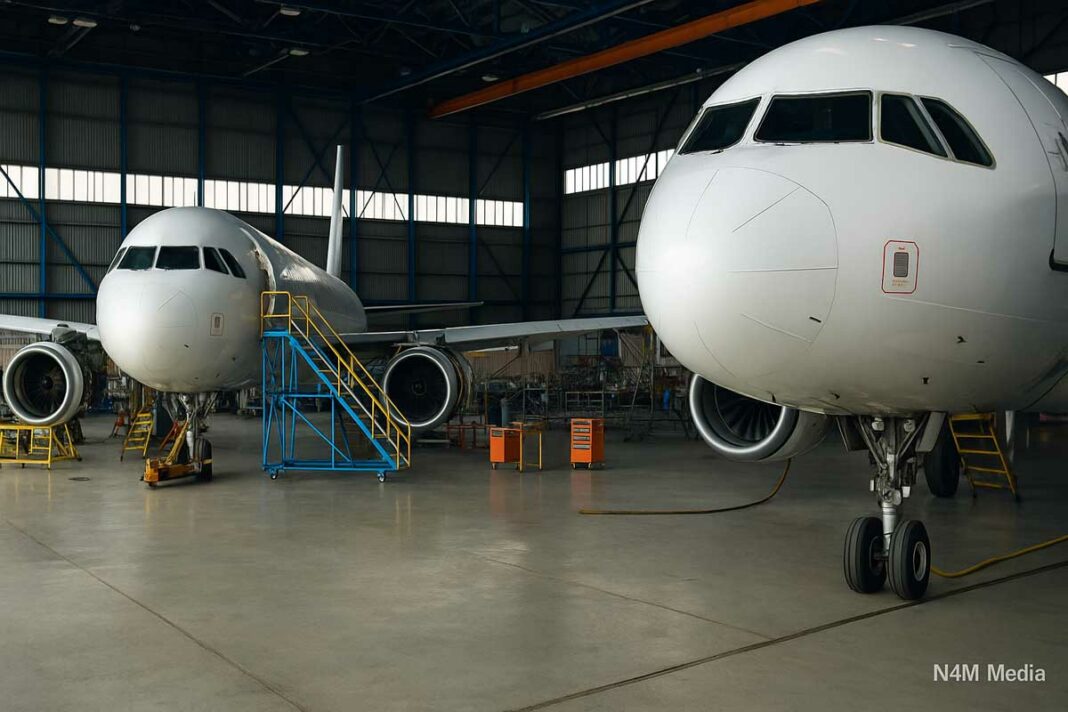
India’s commercial and business-aviation fleets are set for a super-cycle of maintenance demand through the 2030s. Global forecasters see the worldwide MRO market rising from about $119B in 2025 to $156B by 2035, powered by a larger and aging fleet – dynamics that also apply to India. Oliver Wyman At home, government policy has flagged MRO as strategic and growth-worthy, with NITI Aayog explicitly calling out the need to scale domestic capability.
Yet the structure of India’s MRO marketplace is changing fast – raising a red flag for competition, pricing, and access, while putting to test the utility or existence of Competition Commission of India.
The consolidation wave (and why it matters)
- Air Works → Adani: India’s largest private MRO moved under Adani Defence & Aerospace via a binding acquisition process now completed to an ~85% stake – a scale move that instantly concentrates capacity, customers and certifications.
- Indamer Technics → Adani/Prime Aero JV: A binding agreement to acquire 100% of Indamer Technics (AAR Indamer) via a JV (Horizon Aero Solutions) further expands the same group’s footprint – Nagpur MIHAN’s large-aircraft facility among the crown jewels.
On the FBO/GAT side, Delhi long ran with two concessionaires (Bird-ExecuJet and Indamer-MJETS), a model the ‘business aviation’ community has criticized since 2016 for access frictions and vendor eviction risk. Aviation International News More recently, Delhi’s FBO landscape has shifted again with a second FBO arrangement on the field – proof that airport-level choices can be made, but also a reminder that who gets chosen determines downstream access for everyone else.
Why this matters: When the same few hands control (1) hangar bays, (2) OEM relationships, and (3) the FBO choke-points that decide who gets onto the apron and when, smaller CAR-145 shops can be priced out, queued out, or contractually locked out. The result isn’t just fewer competitors – it’s a quiet tax on operators via higher effective turnaround costs, longer AOGs, and less bargaining power.
Counter-currents you should know (it’s not all consolidation)
There are positive new entrants and expansions that could dilute concentration – if policy steers fairly:
- Safran’s LEAP engine MRO in Hyderabad (ops from 2026) adds a global OEM heavyweight into India’s capability stack.
- IndiGo’s ₹1,100 cr MRO at BLR strengthens domestic airframe capacity and skill pipelines.
- Tata–Lockheed’s C-130J defence MRO broadens heavy-platform know-how (spillovers help the ecosystem).
These moves are good for India – but they don’t, by themselves, solve access. Without non-discriminatory slotting, fair FBO terms, and transparent tariff governance, new capacity can still be fenced off from independents.
Are we heading for “IndiGo-style” dominance – this time in MRO?
A single airline’s commercial dominance is one kind of market power; MRO + FBO gatekeeping is another. The risk here is vertical and horizontal leverage: ownership concentration across large MROs, plus control over airport touch-points (FBO/GAT, parking, tows, stands). If left unmanaged, like for example the decade old dominance of Bird and MJET with no space for others at Delhi’s T4 Terminal, the outcome rhymes perfectly with monopoly – even if it isn’t one in law yet. Wonder if Competition Commission of India ever breaks it’s slumber and wakes up to the reality that contradicts the very efforts that MoCA pretends to be aggressively working on.
What to fix – now (a 10-point, pro-competition playbook)
- Airport-level “Open Access” Code: Mandate non-discriminatory apron access and transparent slot-allocation for all DGCA-approved line/base MROs; publish wait-lists and reasons for denial.
- FBO Neutrality Rules: Concession agreements at metro airports should include most-favoured-access clauses for third-party MROs (pricing, bays, ground support), audited annually.
- Tariff Transparency: Publish standardized menus for GSE, towing, GPU, parking, and hangar time; cap ancillary mark-ups at FBOs where there’s limited competition.
- Bay Reservation Quotas: Reserve a minimum % of hangar/stand hours for independent MROs at monopoly or duopoly fields (Delhi, Mumbai) to prevent foreclosure.
- OEM Non-Discrimination Undertakings: As a condition for incentives, OEMs operating facilities in India should sign non-exclusion commitments to support qualified independents with data, tooling, and training on FRAND-like terms.
- Time-to-Serve KPIs: Airports to publish mean/median TAT for independent MRO requests vs in-house/affiliated requests; deviations trigger penalties.
- Competition Test for M&A: For future MRO acquisitions, require an ex-ante competition review (CCI) that considers access to essential facilities (bays, FBOs, tooling, OEM data) beyond traditional market-share math.
- Tier-2 Incentives: Provide reduced land rentals, SGST refunds, and tooling grants for independents in Tier-2/3 airports to decentralize capacity and relieve metro choke points.
- Skill & Certification Pipeline: Fast-track type-training seats and cross-OEM authorisations for independent CAR-145s; tie MoCA incentives to third-party inclusion.
- Single-Window AOG Protocol: DGCA-led protocol so AOG requests get priority slots and neutral access – no operator should be stranded because an FBO “can’t accommodate” an unaffiliated MRO.
The prize if we get it right
India currently outsources a large share of commercial MRO; policy aims to reverse that. With global players (Safran) and domestic capex (IndiGo, defence MROs) entering, we can capture far more value provided access is fair and predictable. Do that, and independents won’t just survive – they’ll specialize (structures, interiors, avionics mods, bizav heavy checks), raising quality and lowering total cost of maintenance for operators.
Bottom line
Consolidation isn’t automatically bad – but concentration without guardrails is. India has a rare window to write pro-competition access rules while the new MRO capacity is still being built. If we protect open access at airports and FBOs, empower independents, and demand OEM neutrality, India won’t slide into an MRO monopoly – it will build a resilient, multi-player ecosystem that serves airlines, NSOPs, and safety alike.