

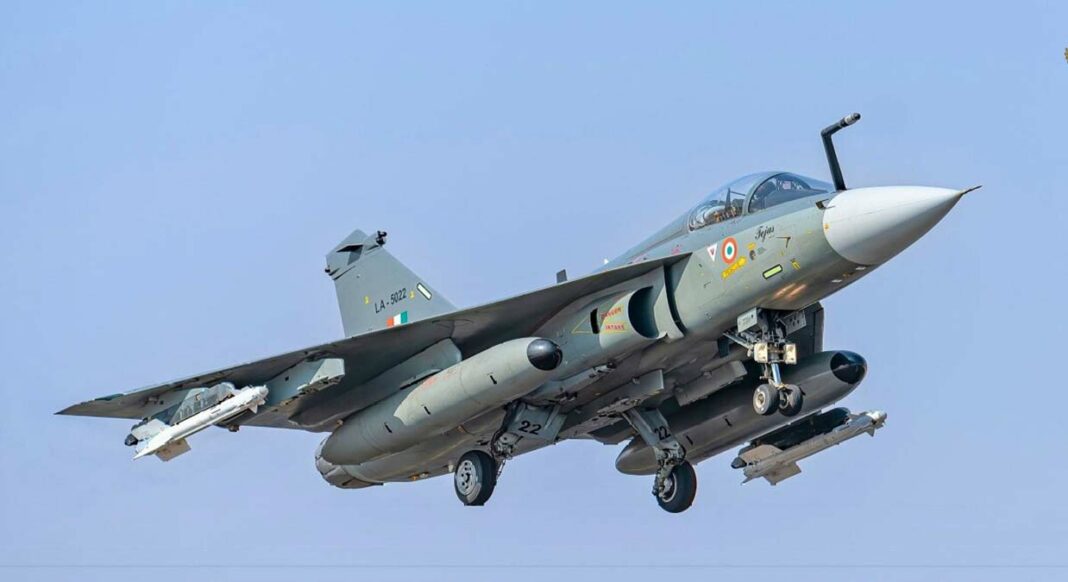
Inaugurating the two-day national seminar ‘Aeronautics 2047’ organised by the Aeronautical Development Agency (ADA), commenced at Centre for Airborne Systems (CABS), Bengaluru on January 04, 2026, Chief of the Air Staff Air Marshal AP Singh said meeting commitment schedules was critical at a time when the operational environment was rapidly evolving and requirements of the Indian Air Force (IAF) were growing, even as he congratulated ADA on the completion of 25 years of Light Combat Aircraft (LCA) Tejas. ‘Aeronautics 2047’ was also to trace the journey of LCA Tejas from early design sketches to operational squadrons, The LCA Mk-1A, an advanced variant of Tejas, is expected to serve as a key platform for meeting the IAFs operational requirements.
The LCA MK-2 and the naval variant are currently under development. Secretary, Department of Defence Research and Development, and Chairman of the Defence Research and Development Organisation (DRDO), Dr Samir V Kamat stressed the importance of developing indigenous technology to reduce dependence on imports. This, he said, was central to achieving the vision of Viksit Bharat.
The IAF has been facing a severe shortage of fighter squadrons – now just about equalling the Pakistan Air Force (PAF). This is not the first time the Chief of Air Staff Air Chief Marshal ACM AP Singh has publicly raised the issue of slippage in the delivery schedule of LCA Tejas. Amid these continuing serious concerns of the IAF regarding fighter squadron shortages and delays in LCA Tejas deliveries, which has a direct bearing on national security, Dr Samir Kamat has now assured that even as HAL Tejas LCA Mk-1A is in the early stages of induction into the IAF, both the fifth-generation Advanced Medium Combat Aircraft (AMCA) and LCA Tejas Mark-II are on schedule.
Speaking on the sidelines of an event to mark the 25 years of the LCA Tejas flight programme, Kamat said, “LCA has been a marvellous journey. Now this aircraft is inducted. Now our focus is on the Mark-II variant of LCA and AMCA. Both these programs are now on schedule, and we hope to deliver our commitment to the Indian Air Force.” The first flight of Mark-II, according to him, is expected to happen in June-July 2026, and AMCA is likely to be rolled out by the end of 2028. The first flight of the aircraft may happen by early 2029. He said AMCA, being a fifth-generation aircraft, will have several new technologies. “It’s a stealth aircraft, so several new technologies will come in with AMCA,” he was quoted as saying.
According to Kamat, the decision to target the June–July 2026 window for the first flight of Tejas Mk II is based on rigorous internal assessments regarding design finalisation, subsystem integration, and pre-flight clearances. If this schedule is met, it will mark a pivotal moment for Indian military aviation. The LCA Mk2 is not merely an upgrade but a substantial evolution over the existing Tejas Mk1/Mk1A variants. Often referred to as a Medium Weight Fighter (MWF), the Mk2 is designed with a Maximum Take-Off Weight (MTOW) of 17.5 tonnes, significantly heavier than the 13.5-ton Mk1A. It will be powered by the robust General Electric F414-INS6 engine, generating 98 kN of thrust, and will feature close-coupled canards for improved manoeuvrability. This platform is envisioned as the bridge to India’s future fifth-generation fighter programmes, such as the AMCA.
It is no secret that the major reason for delay in the Tejas program is the inordinate delivery of aeroengines by GE. It would be naïve to believe that this was due to reasons beyond the control of GE. For months our media has been talking of GE transferring 100% technology of the F-404 engine to India; which obviously was fake propaganda. The latest now is that GE and Hindustan Aeronautics Limited (HAL) is expected to finalize the F414 Engine technology transfer deal by March 2026, and the first indigenous unit targeted by 2029. According to sources close to the development, negotiations for the prospective USD 1.5 billion contract have been concluded, establishing a framework for an unprecedented 80% Transfer of Technology (ToT). Once approved by both governments, a process anticipated to complete within the first quarter of 2026, HAL is to commence the phased absorption of critical manufacturing technologies; with the goal to establish a comprehensive domestic ecosystem for building, servicing, and sustaining these advanced propulsion systems.
The Cabinet Committee for Security (CCS) had approved the Tejas Mk2 program in September 2022, allocating nearly INR 10,000 crore for its development. However, this approval included a crucial condition. Prototype development would begin only after India achieved clarity on the jet engine partnership with the United States. Compare this with the ToT for the aeroengine yet to be signed – hopefully by March 2026. But the ToT is only for 80%, which implies the control will remain with the US. This does not inspire much confidence, with the delays in delivery of F-404 previously signed and agreed to by GE (only five received?), as well as the inordinate delay in delivering Apache helicopters. While the negotiating team has reportedly committed USD 1.5 billion in the deal but with only 80% ToT the control will remain with the US; a country which is highly unreliable and can switch off anytime – the indirect Kill Switch.
Witness Donald Trump now lying that Prime Minister Narendra Modi asked “may I see you please” and then requested him for 68 Apache helicopters, which would be delivered on time. Trump has now threatened Inda with 500% tariffs for buying Russian oil. There is every reason to believe that the Trump Administration behind the Tejas jet crash at the Dubai Air Show in which the pilot Wing Commander Namansh Syal was killed. Trump’s attack on Venezuela, bombing of Caracas without declaration of war, abducting President Maduro and his wife Cilia Flores who was apparently tortured as is visible in this tweeted picture of hers, indicates Trump is Satan incarnate.

The US, UK, Russia, France, and China are the primary nations with comprehensive, self-reliant jet engine industries for advanced fighters and commercial jets. In our case, development of the Kaveri engine, which began in 1986, has taken nearly 40 years and is suitable only for UAVs; it cannot power the Tejas. Compare this with the US, UK, Russia, France, and China having indigenous engines to power their advanced fighters and commercial jets. Britain’s jet fighter engine development took roughly a decade; operational deployment, with the Frank Whittle turbojet in 1930 and the first British jet, the ‘Gloster Meteor’, flying in 1943. The US developed its first viable jet fighter engines relatively quickly by adapting British designs, with GE running its first jet engine in about a year (1941-1942) after licensing Whittle’s technology. What is so special about these countries that we couldn’t do the same? Has this been by default or design – it certainly raises a stink.
In 1979, the Japanese ambassador to India, addressing the Defence Services Staff College at Wellington, said there was a time when Japan was nowhere in computers. So, the government called the scientists, industry, academia and said this is the money and place to work, we want to beat America in five years; Japan did it in three years. Aero Engines are far more complex than computers but shouldn’t that have been our approach rather than banking only on DRDO and the Kaveri engine?
The author is an Indian Army veteran. Views expressed are personal.














 Tejas remains crucial for the Indian Air Force, shaping future aviation strategies & operational needs.)