

A few years ago, talking to your phone in public still felt slightly embarrassing. People lowered their voices while using voice notes. Many still preferred typing broken sentences over speaking naturally into a device that could barely understand them.
Today, that hesitation is quietly disappearing.
Across India, millions of people already speak to technology more than they type into it. Auto drivers navigate through voice commands. Families communicate through WhatsApp voice notes. Elderly parents who struggle with keyboards can still operate YouTube comfortably because they can simply ask for what they want. Somewhere in a small town, a shopkeeper who may never type a full email in English can still use voice search fluently.
That shift received another major push this week when OpenAI introduced a new set of voice AI models capable of real-time reasoning, translation, and transcription, allowing developers to build more natural multilingual voice applications.
On the surface, it sounds like just another AI announcement in an industry overflowing with them. But underneath it lies something much bigger: technology is slowly moving away from typing and inching closer to natural human conversation.
And India may be one of the biggest beneficiaries of that transition.
The keyboard era may not end dramatically. It may simply fade into the background while people continue talking naturally to machines that are finally learning how humans actually communicate.
What makes this moment particularly interesting is that India has already been preparing for a voice-first internet without fully realizing it.
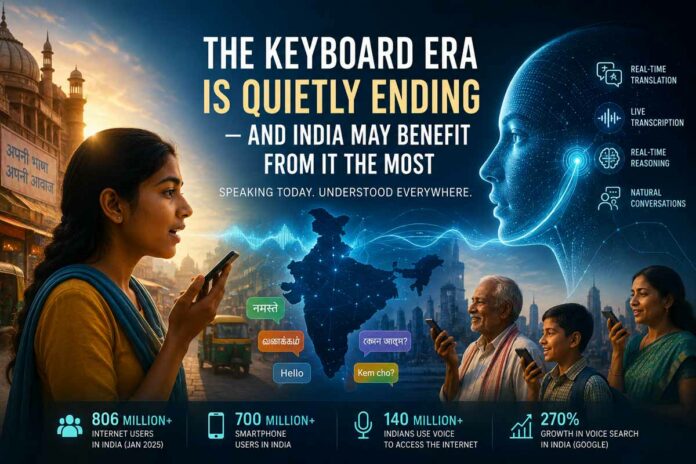
India had over 806 million internet users at the beginning of 2025, with nearly 49 million new users added in just one year. Much of this growth is coming from mobile-first and rural audiences, where typing-heavy digital behavior was never deeply ingrained in the first place.
For decades, typing silently acted as a gatekeeper to the digital world. To type efficiently, users needed familiarity with keyboards, spelling, interfaces, and often English itself. But speaking is instinctive. People who struggle to write formal English can still communicate ideas clearly in Hindi, Punjabi, Bengali, Tamil, Gujarati, or a natural mix of several languages at once.
India has always communicated in layers. We switch languages mid-sentence. We mix dialects casually. We shorten words, bend grammar, and create hybrid expressions that somehow make perfect sense to us. Traditional computing systems were never designed for this kind of fluid communication. Humans adapted themselves to machines instead.
Voice AI is beginning to reverse that relationship. For the first time, technology is adapting to how people naturally speak.
Because once technology understands speech naturally, the internet stops feeling like a system to learn and starts feeling like a conversation.
The rise of voice AI also aligns perfectly with how Indians already use the internet. India largely skipped the desktop era and embraced smartphones directly. Today, the country has more than 700 million smartphone users, while regional-language internet usage continues to surge. Google had earlier reported a 270% growth in voice searches in India, long before the generative AI boom began.
The behavioural shift is already visible everywhere.
WhatsApp voice notes have become a default communication tool across age groups. Voice search on YouTube is increasingly common. According to IAMAI and Kantar data, more than 140 million Indians already rely on voice commands to access the internet. In multilingual environments like India, speaking often feels faster, easier, and far less intimidating than typing.
This is why features like real-time translation and AI-powered transcription may see massive adoption in India far beyond corporate meetings or productivity apps.
Imagine customer support where language barriers disappear instantly. Imagine students attending lectures translated live into regional languages. Imagine small business owners interacting with banking systems or government portals without worrying about typing proficiency. Imagine elderly users finally engaging with technology independently rather than depending on younger family members to navigate interfaces for them.
The implications are bigger than convenience. They touch accessibility, inclusion, and participation.
Voice technology could reduce the quiet intimidation millions of Indians still feel while interacting with digital systems.
At the same time, this transition also changes how we think about communication itself. Keyboards encouraged people to communicate in structured, edited, deliberate ways. Voice is messier. More emotional. More human. It carries hesitation, excitement, pauses, accents, and personality. In many ways, voice AI is pushing technology toward something more conversational and less mechanical.
Ironically, after decades of humans learning to speak like machines through commands, keywords, and rigid interfaces, machines are now learning to speak more like us.
Of course, challenges remain. Accuracy across India’s countless accents and dialects is still evolving. Questions around privacy, consent, and voice data ownership will become increasingly important. And there is always the risk that convenience may outpace regulation.
But despite those concerns, the larger direction feels clear.
The future of computing may not belong to the fastest typists anymore. It may belong to the people who can simply speak – naturally, imperfectly, in the language they grew up with – and finally be understood.